Only for GDS by GDS - India Post

Only for GDS by GDS - India Post

Wednesday, 2 January 2019

Types of Rural Postal Life Insurance (RPLI) plan

Types of Rural Postal Life Insurance (RPLI) came into being like a sequel to the recommendations of the Official Committee for Reforms in the Insurance Sector (Malhotra Committee). The Committee had observed in 1993 that only 22% of the insurable population in this country had been insured; life insurance funds accounted for only 10% of the gross household savings.
The Committee had observed: “The Committee understands that Rural Branch Postmasters who enjoy a position of trust in the community have the capacity to canvass life insurance business within their respective areas…..” 

The Government accepted the recommendations of Malhotra Committee and allowed Postal Life Insurance to extend its coverage to the rural areas to transact life insurance business with effect from 24.3.1995, mainly because of the vast network of Post Offices in the rural areas and low cost of operations. The prime objective of the scheme is to provide insurance cover to the rural public in general and to benefit weaker sections and women workers of rural areas in particular and also to spread insurance awareness among the rural population. As on 31.03.2017, we have more than 146 Lacs policies.▪So let's talk about the types of rural postal life insurance plan details today. 

Rural Postal Life Insurance (RPLI) plan Eligibility 
The scheme shall cover all persons, male or female, who permanently reside in rural areas and are ordinarily residents in India to the exclusion of foreigners and non-resident Indians provided they have attained majority So let's talk about the types of rural postal life insurance plan details today ▪ 
Types of Rural Postal Life Insurance (RPLI) plan details
Rural Postal Life Insurance (RPLI) scheme was introduced in 1995 for the benefit of rural populace to extend insurance coverage to people living in rural areas with special emphasis on weaker sections and women workers as a result of the recommendation of the Official Committee for Reforms in the Insurance Sector (Malhotra Committee).
RPLI offers the following six types of policies: 
  1. Whole Life Assurance (Gram Suraksha) 
  2. Endowment Assurance (Gram Santosh)
  3. Convertible Whole Life Assurance (Gram Suvidha) 
  4. Anticipated Endowment Assurance (Gram Sumangal) 
  5. 10 Year RPLI (Gram Priya) 
  6. Children Policy (Bal Jeevan Bima)
Salient Features of Types of Rural Postal Life Insurance (RPLI) plan details

1. Whole Life Assurance (Gram Suraksha) 

This is a scheme where the assured amount with accrued bonus is payable to the insured either on attaining the age of 80 years or to his/her legal representatives or assignees on the death of the insured, whichever occurs earlier, provided the policy is in force on the date of claim. 
• Minimum & Maximum age at entry: 19-55 years 
• Minimum Sum Assured ₹ 10,000; Maximum ₹ 10 lac 
• Loan facility after 4 years • Surrender after 3 years 
• Last declared Bonus- ₹ 65/- per ₹ 1000 sum assured per year 

2. Endowment Assurance (Gram Santosh) 

Under this scheme the proponent is given an assurance to the extent of the sum assured and accrued bonus till he/she attains the predetermined age of maturity i.e 35,40,45,50,55,58 & 60 years of age. • In case of death of insurant, assignee, nominee or legal heir is paid the full amount of sum assured with accrued bonus 
• Minimum & maximum age at entry: 19-55 years 
• Minimum sum assured ₹ 10,000; Maximum ₹ 10 lac 
• Loan facility after 3 years • Surrender after 3 years 
• Last declared Bonus- ₹ 50/- per ₹ 1000 sum assured per year 

3. Convertible Whole Life Assurance (Gram Suvidha) 

A Whole Life Assurance Policy with the added feature of an option to convert to Endowment Assurance Policy at the end of five years of taking policy. 
• Assurance to the extent of sum assured with accrued bonus till attainment of maturity age 
• In case of death, assignee, nominee or legal heir paid the full amount of sum assured with accrued bonus 
• Minimum age & Maximum age at entry: 19-45 years 
• Minimum sum assured ₹ 10,000; Maximum ₹ 10 lac • Loan facility after 4 years 
• Surrender after 3 years 
• Last declared Bonus- ₹ 65/- per ₹ 1000 per year (for WLA policy if not converted to Endowment Assurance) 

4. Anticipated Endowment Assurance (Gram Sumangal) 

It is a Money Back Policy with maximum sum assured of ₹ 10 lacs, best suited to those who need periodical returns. Survival benefits are paid to the insurant periodically. Such payments will not be taken into consideration in the event of an unexpected death of the insurant. In such cases, full sum assured with accrued bonus is payable to the assignee, nominee of the legal heir.
• Policy term: 15 years and 20 years 
• Minimum age 19 years; maximum age at entry 40 years for 20 years’ term policy & 45 years for 15 years’ term policy 
• Survival benefits paid periodically as under: - 
• 15 years Policy- 20% each on completion of 6 years, 9 years & 12 years and 40% with an accrued bonus on maturity 
• 20 years Policy- 20% each on completion of 8 years, 12 years & 16 years and 40% with an accrued bonus on maturity 
• Last declared Bonus- ₹ 47/- per ₹ 1000 sum assured per year 

5. 10 Years Rural PLI (Gram Priya) 

It is a short-term money back scheme for Rural populace only
• Insurant is given life cover to the extent of Sum Assured for 10 years. 
• Survival benefits are paid after 4 years- 20% after 7 years- 20%, and after 10 years – 60% with accrued bonus 
• Minimum & maximum age at entry 20 – 45 years • Minimum sum assured ₹ 10,000, maximum 10 lacs 
• No interest is charged up to one year as arrears of premia in case of natural calamities like flood, drought, earthquake, cyclone etc. 
• Last declared bonus ₹ 47/- per ₹ 1000/- sum assured per year.

6. Children Policy (Bal Jeevan Bima) 

The salient features of this scheme are as under: 
• The scheme provides life insurance coverage to children of policyholders. 
• Maximum two children of the policyholder (parent) are eligible 
• Children between 5- 20 years of age are eligible 
• Maximum sum assured ₹ 1 lac or equal to the sum assured of the parent, whichever is less 
• Policyholder(parent) should not be over 45 years of age. 
• No premium to be paid on the Children Policy, on the death of policyholder (parent). Full sum assured and bonus accrued shall be paid on completion of a term 
• No medical examination of child necessary. However, a child should be healthy and risk shall start from the day of acceptance of a proposal 
• Attract the rate of bonus applicable for Endowment policy (Gram Santosh) i.e. last bonus rate is ₹ 50/- per ₹ 1000 sum assured per year.

Rural Postal Life Insurance is a great insurance product for rural areas which can not be imagined that you may have received information from the picture of Types of Rural Postal Life Insurance (RPLI) plan details. 

Saturday, 22 December 2018

Thursday, 20 December 2018

GDS Stike to be continued...

STRIKE WILL BE CONTINUES

Dear comrades, colleagues,

Receiving very good report from all circles. Strike is in full swing. Ensure 100%strike from each Division. Strike will continue till DOP settle our demands. 

SS Mahadevaiah, 
General Secretary, AIGDSU.

P. U. Muraleedharan, 
General Secretary, 
NUGDS

CHQ received good report regarding strike percentage. Red salute to all. this is not enough to put pressure on the department. We have to fight with full strength. Request every GDS to participate in the strike. IMPROVE STRIKE percentage day by day. We shall reach our goal.


SS Mahadevaiah, 
General Secretary, 

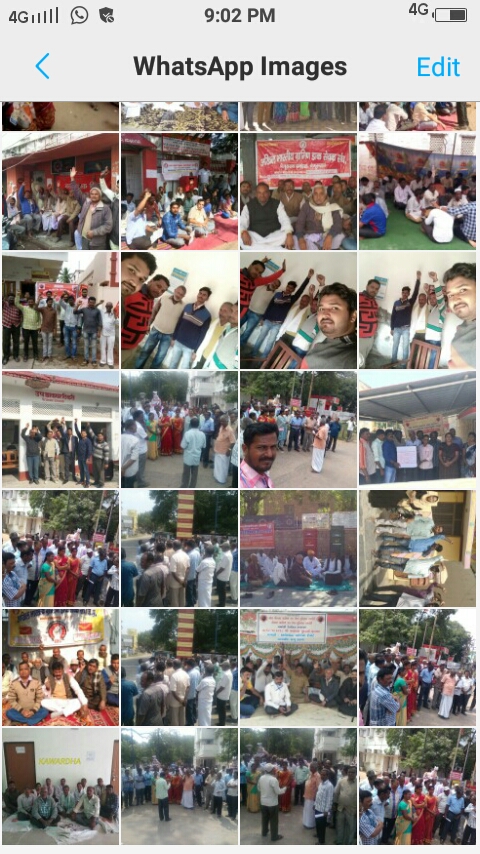
STRIKE WILL BE CONTINUES [ GDS Strike Photos on 19/12/2018]

STRIKE WILL BE CONTINUES


DOP Adamant Intensify the Strike


DOP is Adamant. Intensify the Strike.


Meeting with sri AN Nanda,Secretary ( P) along with Sri Salim Haque, Member( Tech), Sri Vinit Pandey, Member (PLI), DDG (SR&Legal), DDG ( Estt).


Mr BV Rao, President, AIGDSU, Mr Mahadevaiah, General Secretary, and P. U. Muralidharan, General Secretary, NUGDS are attended from GDS JCA.
Secretary (P) Appealed that call off the Strike. JCA refused to call off the strike without settlement.

The following letter was given to the JCA.

SS. Mahadevaiah General Secretary, AIGDSU
P. U Muralidharan, General Secretary, NUGDS


Press Statement

Press Statement


All Postal Services in Rural India Closed.
Gramin Dak Sevaks Indefinite Strike from 18-12-2018.


Thursday, 15 November 2018

Importance of Jan 2019 2 Days Strike – Confederation

National Convention of Workers organized by Central Trade Unions (except BMS), independent Federations and Associations viz; Central Government and State Govt. Employees, Banks, Insurance, Defence production employees etc, held at Mavlankar Hall, New Delhi on 28th September 2018, has decided to conduct two days nationwide strike on 8th& 9th January 2019. Earlier, Confederation of Central Govt. Employees & Workers, in its National Convention held at Hyderabad on 10th June 2018, has decided to go for one day’s nationwide strike on 15th November 2018, demanding settlement of 10 points Charter of demands of Central Govt. Employees, Pensioners, Gramin DakSevaks and casual/contract workers. In the changed circumstances, Confederation has decided to postpone the 15th November 2018 one day strike and to join the two days strike on 8th and 9thJanuary 2019 announced by the National Convention of Workers. There is no change in the 10 points charter of demands of Confederation adopted in the Hyderabad National Convention.

The declaration adopted in the National Convention of Workers held on 28th September 2018 has stated as follows:

“Government is dragging its feet on wage negotiations of public sector in bipartite settlement and 7th Central Pay Commission anomalies of Central Government employees. Four sub committees were formed by the Government to address several issues raised by Central Government employees (NJCA) such as scrapping of New Pension Scheme (NPS) review of Minimum wage and fitment formula, restoration of allowances and allowing option-I as one of the pension benefit formula. But nothing has been done.

The Central Government Employees organisations including the Defence and Railways have been planning united action against the betrayal of the Government and asserting their genuine demands including scrapping of New Pension Scheme. This National Convention extends full support to their struggle and upholds all their demands.”

Thus, the entire Trade unions (other than BMS) has taken serious view of the negative attitude of the Central Government towards the demands of Central Government employees and Pensioners and extended full solidarity and support to our struggle.

Unrest among the New Pension Scheme (NPS) employees is rising day by day. Those NPS employees who retired from service, in 2015 to 2018, after completing ten years’ service are getting a paltry sum of Rs.1000 to 3000 only as monthly annuity pension. How can a pensioner and his family live with such a megre amount as pension. This is equal to “No Pension”, Under the Old Pension Scheme (OPS) an employee who completed minimum ten yearsservice is eligible for 50% of last pay drawn as minimum pension.

Regarding increase in Minimum Pay and Fitment formula, the assurance was given to the NJCA leaders by none other than the Hon’bleHome Minister and Finance Minister on 30.06.2016. Two years are over but nothing happened. Government has replied in Parliament that, at present, there is no proposal for increasing Minimum Pay and Fitment formula. Thus the entire Central Govt. Employees are betrayed. Regarding Pensioners, the one and the only favourable recommendation of the 7th CPC i.e. Option-I, stands rejected by Government.

Three lakhs GraminDakSevaks of the Postal department conducted a heroic strike for sixteen days and finally Govt. was compelled to accept their demands.But while issuing orders, eventhough new pay scale recommended by the Kamalesh Chandra Committee is implemented, regarding arrears the Committee’s recommendation was rejected and modified by Govt. Some important recommendations like Children Education Allowance, Time bound three financial upgradations etc. are still pending. Regarding revision of wages of Casual Labourers, orders issued by Postal Directorate is yet to be implemented in some Circles and Divisions and their demand for regularisation is not considered favourably by Govt.

The situation in the country is deteriorating day by day. National economy including value of Indian currency, suffered serious setback due to pro-corporate, anti-labour and anti-people neo-liberal policies pursued by the Central Government, grievously impacting the livelihood of the working people and farmers.

The situation due to steep rise in petrol and diesel prices with cascading effect on increase in prices of all daily life utility items, especially food items, is resulting in torturous impact on common masses. The unemployment situation is getting aggravated with employment generation practically turned negative even in most labour-oriented sectors. The agricultural sector and farmers are in deep distress. The after-effects of demonitisation and faulty GST Continue to adversely impacting the deep crisis set in the fast-paced neo-liberal economic policies of the Government. Lack of job opportunities on the one hand and continued job losses, retrenchments, illegal closures on the other hand are imposing miserable condition on the ordinary families for their food, education of children and medical care of the sick and elderly, Aggressive move to sell the shares of the Public Sector undertakings and onslaught of privatization through various routes like outsourcing, PPP etc. is going on in full swing. The demand for universal social security with guaranteed pension has fallen on deaf ears.

Central Govt. not only refused to respond to the just and genuine demands of the organized agitation of working class, but has been continuing its aggression against the hard-won labourrights of the workers, employees and Trade Unions. It is in this background the entire working class of our country has decided to fight back the onslaught of the Govt. against the working class and peasants.

National Federation of Postal Employees (NFPE) has been in the forefront of the struggle against the neo-liberal policies of the Govt. especially against the negative attitude of the Govt. towards the Central Govt. Employees demands including Postal employees.

On January 8th& 9th, about 18 to 20 crores organized and unorganized workers will go on two days strike. NFPE HQ calls upon the entirety of Postal and RMS employees including GraminDakSevaks and Casual, Part-time, Contingent employees to join the strike en-mass. It is a struggle for our survival.

Source: Confederation