Only for GDS by GDS - India Post

Only for GDS by GDS - India Post
Showing posts with label Indefinite Strike. Show all posts

Thursday, 20 December 2018

GDS Stike to be continued...

STRIKE WILL BE CONTINUES

Dear comrades, colleagues,

Receiving very good report from all circles. Strike is in full swing. Ensure 100%strike from each Division. Strike will continue till DOP settle our demands. 

SS Mahadevaiah, 
General Secretary, AIGDSU.

P. U. Muraleedharan, 
General Secretary, 
NUGDS

CHQ received good report regarding strike percentage. Red salute to all. this is not enough to put pressure on the department. We have to fight with full strength. Request every GDS to participate in the strike. IMPROVE STRIKE percentage day by day. We shall reach our goal.


SS Mahadevaiah, 
General Secretary, 

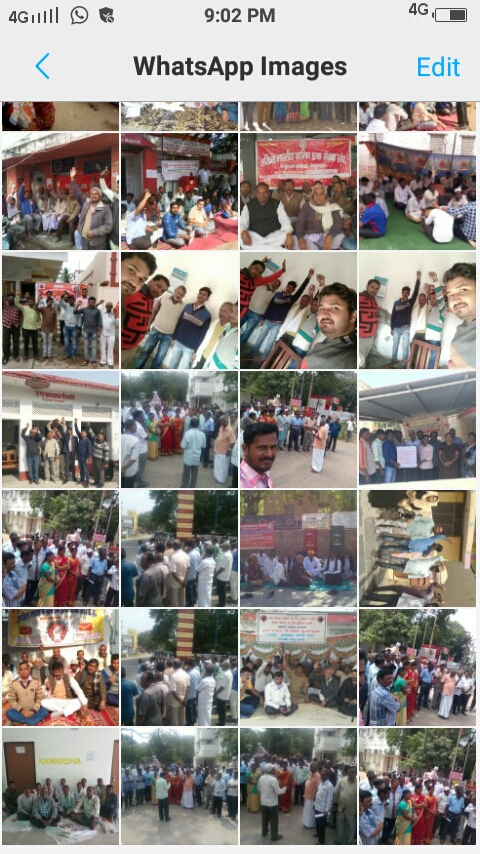
STRIKE WILL BE CONTINUES [ GDS Strike Photos on 19/12/2018]

STRIKE WILL BE CONTINUES


DOP Adamant Intensify the Strike


DOP is Adamant. Intensify the Strike.


Meeting with sri AN Nanda,Secretary ( P) along with Sri Salim Haque, Member( Tech), Sri Vinit Pandey, Member (PLI), DDG (SR&Legal), DDG ( Estt).


Mr BV Rao, President, AIGDSU, Mr Mahadevaiah, General Secretary, and P. U. Muralidharan, General Secretary, NUGDS are attended from GDS JCA.
Secretary (P) Appealed that call off the Strike. JCA refused to call off the strike without settlement.

The following letter was given to the JCA.

SS. Mahadevaiah General Secretary, AIGDSU
P. U Muralidharan, General Secretary, NUGDS


Press Statement

Press Statement


All Postal Services in Rural India Closed.
Gramin Dak Sevaks Indefinite Strike from 18-12-2018.


Thursday, 15 November 2018

Importance of Jan 2019 2 Days Strike – Confederation

National Convention of Workers organized by Central Trade Unions (except BMS), independent Federations and Associations viz; Central Government and State Govt. Employees, Banks, Insurance, Defence production employees etc, held at Mavlankar Hall, New Delhi on 28th September 2018, has decided to conduct two days nationwide strike on 8th& 9th January 2019. Earlier, Confederation of Central Govt. Employees & Workers, in its National Convention held at Hyderabad on 10th June 2018, has decided to go for one day’s nationwide strike on 15th November 2018, demanding settlement of 10 points Charter of demands of Central Govt. Employees, Pensioners, Gramin DakSevaks and casual/contract workers. In the changed circumstances, Confederation has decided to postpone the 15th November 2018 one day strike and to join the two days strike on 8th and 9thJanuary 2019 announced by the National Convention of Workers. There is no change in the 10 points charter of demands of Confederation adopted in the Hyderabad National Convention.

The declaration adopted in the National Convention of Workers held on 28th September 2018 has stated as follows:

“Government is dragging its feet on wage negotiations of public sector in bipartite settlement and 7th Central Pay Commission anomalies of Central Government employees. Four sub committees were formed by the Government to address several issues raised by Central Government employees (NJCA) such as scrapping of New Pension Scheme (NPS) review of Minimum wage and fitment formula, restoration of allowances and allowing option-I as one of the pension benefit formula. But nothing has been done.

The Central Government Employees organisations including the Defence and Railways have been planning united action against the betrayal of the Government and asserting their genuine demands including scrapping of New Pension Scheme. This National Convention extends full support to their struggle and upholds all their demands.”

Thus, the entire Trade unions (other than BMS) has taken serious view of the negative attitude of the Central Government towards the demands of Central Government employees and Pensioners and extended full solidarity and support to our struggle.

Unrest among the New Pension Scheme (NPS) employees is rising day by day. Those NPS employees who retired from service, in 2015 to 2018, after completing ten years’ service are getting a paltry sum of Rs.1000 to 3000 only as monthly annuity pension. How can a pensioner and his family live with such a megre amount as pension. This is equal to “No Pension”, Under the Old Pension Scheme (OPS) an employee who completed minimum ten yearsservice is eligible for 50% of last pay drawn as minimum pension.

Regarding increase in Minimum Pay and Fitment formula, the assurance was given to the NJCA leaders by none other than the Hon’bleHome Minister and Finance Minister on 30.06.2016. Two years are over but nothing happened. Government has replied in Parliament that, at present, there is no proposal for increasing Minimum Pay and Fitment formula. Thus the entire Central Govt. Employees are betrayed. Regarding Pensioners, the one and the only favourable recommendation of the 7th CPC i.e. Option-I, stands rejected by Government.

Three lakhs GraminDakSevaks of the Postal department conducted a heroic strike for sixteen days and finally Govt. was compelled to accept their demands.But while issuing orders, eventhough new pay scale recommended by the Kamalesh Chandra Committee is implemented, regarding arrears the Committee’s recommendation was rejected and modified by Govt. Some important recommendations like Children Education Allowance, Time bound three financial upgradations etc. are still pending. Regarding revision of wages of Casual Labourers, orders issued by Postal Directorate is yet to be implemented in some Circles and Divisions and their demand for regularisation is not considered favourably by Govt.

The situation in the country is deteriorating day by day. National economy including value of Indian currency, suffered serious setback due to pro-corporate, anti-labour and anti-people neo-liberal policies pursued by the Central Government, grievously impacting the livelihood of the working people and farmers.

The situation due to steep rise in petrol and diesel prices with cascading effect on increase in prices of all daily life utility items, especially food items, is resulting in torturous impact on common masses. The unemployment situation is getting aggravated with employment generation practically turned negative even in most labour-oriented sectors. The agricultural sector and farmers are in deep distress. The after-effects of demonitisation and faulty GST Continue to adversely impacting the deep crisis set in the fast-paced neo-liberal economic policies of the Government. Lack of job opportunities on the one hand and continued job losses, retrenchments, illegal closures on the other hand are imposing miserable condition on the ordinary families for their food, education of children and medical care of the sick and elderly, Aggressive move to sell the shares of the Public Sector undertakings and onslaught of privatization through various routes like outsourcing, PPP etc. is going on in full swing. The demand for universal social security with guaranteed pension has fallen on deaf ears.

Central Govt. not only refused to respond to the just and genuine demands of the organized agitation of working class, but has been continuing its aggression against the hard-won labourrights of the workers, employees and Trade Unions. It is in this background the entire working class of our country has decided to fight back the onslaught of the Govt. against the working class and peasants.

National Federation of Postal Employees (NFPE) has been in the forefront of the struggle against the neo-liberal policies of the Govt. especially against the negative attitude of the Govt. towards the Central Govt. Employees demands including Postal employees.

On January 8th& 9th, about 18 to 20 crores organized and unorganized workers will go on two days strike. NFPE HQ calls upon the entirety of Postal and RMS employees including GraminDakSevaks and Casual, Part-time, Contingent employees to join the strike en-mass. It is a struggle for our survival.

Source: Confederation

Indefinite Strike Notice from 18.12.18 served by NUGDS and AIGDSU unions on 14/11/2018

Indefinite Strike Notice from 18.12.18 served by NUGDS and AIGDSU unions today

Wednesday, 11 July 2018

58th Anniversary of Glorious Strike of Central Government Employees

Today, is the 58th anniversary of the Glorious Strike of the Central Government Employees which started on 11th July 1960 and continued for 5 days on the basic demands of the workers. That was their biggest strike in independent India till then, which shook the edifice of the Government.

It was suppressed by all repressive measures putting thousands in jail, dismissal, termination etc. But the workers never surrendered. The mighty one day Token Strike on 19th September 1968 reminded the Government that the workers can never be suppressed all the times.

On this day our Revolutionary salutes to all those comrades who sacrificed their lives at the altar of struggle and also who faced inhuman suppression and also the lakhs of workers who participated. Red Salute to all those who showed through their action that the united struggle is the right path.


Thursday, 14 June 2018

POSTAL WORKERS STRIKE :: Colonial hangover :: FRONT LINE (JUNE-2018)

FRONT LINE
POSTAL WORKERS STRIKE
Colonial hangover
Print edition : June 22, 2018

The Central government ignores a nationwide strike by rural postal workers who are struggling to be recognised as full-time employees of the Postal Department in order to receive living wages at a time when they find their workload substantially increased to keep government schemes afloat.

WHILE delivering his Independence Day speech from the ramparts of the Red Fort in 2016, Prime Minister Narendra Modi spoke glowingly of the post office as an example of national identity and of how the postman was loved by everyone and vice versa. He also said that post offices would be converted into payments banks. This was the time when Jan Dhan accounts were being opened and plans were on to pay Mahatma Gandhi National Rural Employment Guarantee Act (MGNREGA) wages through banks and post offices. The Department of Posts was expected to be the leading agency for disbursements under the Direct Benefit Transfer (DBT) and Payment System. It was, after all, the backbone of the country’s communication system. Under the India Post Payments Bank system, the Postal Department was to tie up with 11 departments to disburse MGNREGA wages, DBT, subsidies, scholarships, and old age and disabled pensions.

All this certainly made for a heavier workload for the rural postman. But if Modi’s speech contained any note of promise for post offices and the bulk of their workforce spread across India’s villages, it never saw fruition. On May 22, nearly two and a half lakh gramin dak sevaks (GDSs) started an indefinite strike demanding the implementation of the recommendations of the “gramin dak sevak committee”, or the Kamlesh Chandra Committee, which in November 2016 had made strong recommendations in their favour and described these workers as the “soul” of the Department of Posts.

Of the 1,55,015 post offices in the country, 1,29,379 (83.5 per cent) are rural post offices served by gramin dak sevaks. These form the bulwark of the Postal Department, which boasts the world’s largest network of post offices. Yet, rural postal workers have never been given the status of full-fledged government employees.

P. Panduranga Rao, a branch postmaster from Nellore and general secretary of the All India Postal Employees’ Union-Gramin Dak Sevaks, said: “All these are branch post offices. The bulk of the work is done by them and gramin dak sevaks. But there are two sections of employees; those with the Department of Posts, who are equivalent to Central government employees, and gramin dak sevaks, who are yet to be regularised despite being the main medium of communication between the Central government and the rural masses.” It is a situation that has persisted for over a century.

The Kamlesh Chandra Committee was set up in November 2015. Its brief was to examine gramin dak sevaks’ working conditions, wage structure, social security benefits and welfare measures in the light of proposals to induct technology in rural post offices. It submitted its report in November 2016 with exhaustive recommendations.

One and a half years later, as the Modi government celebrates its four years in office, the report remains unimplemented and the government seems oblivious to the plight of the rural postal workforce. When, on May 14, unions representing nearly three lakh gramin dak sevaks served notice for an indefinite strike beginning on May 22, it went largely unnoticed and was ignored in the mainstream national media.

Kamlesh Chandra, who headed the committee, was a retired member of the Postal Services Board and hence best suited to understand the gramin dak sevaks’ situation. His was not the first committee on the gramin dak sevaks; five committees had been set up after 1957. But the Kamlesh Chandra Committee made a strong pitch for improvement in the “quality of life of the GDS” and for harmonising their wages and emoluments in tune with present-day needs and aspirations of young recruits joining the workforce. In the course of its interactions with gramin dak sevaks, the committee found that many of them had no other source of income.

The committee cautioned that the objectives of enabling information and communication technology (ICT) in rural financial services and getting business from payments banks would be defeated if the “reasonable demands and aspirations” of gramin dak sevaks were not looked into. This was all the more important in view of the government’s avowed focus on “agriculture, farmers’ welfare, development of rural infrastructure, rural employment, rural enterprises, rural housing, i.e comprehensive rural development” and the business opportunities that had been created in banking, insurance, third party business and ecommerce in GDS post offices.

The Kamlesh Chandra Committee report stated that the GDS post offices “constitute 83.5 per cent of the total post office network and [are] considered as the Unique Selling Proposition for the department because of their reach, trustworthiness and accountability”. Gramin dak sevaks, the committee said, were the “ambassadors of the Department of Posts, Ministry of Communications, in the rural and remote areas of India” and “represent the Government of India (GoI) in the far-flung areas of the country where barely any other representative of GoI exists and therefore create a strong organic channel between the Central government and citizens of rural India to transfer the benefits of growth”.

CENTURY OF NEGLECT
The history of gramin dak sevaks, like that of the rest of the postal system, goes back more than a century. The British called them extra departmental agents, or EDAs. The EDAs were teachers, shopkeepers and pensioners who provided basic postal services to rural people in their spare time in return for a compensation. Ironically, no Central government in independent India deemed it fit to regularise their services. Regularisation, therefore, has been one of their major demands. They are considered as being “outside the Civil Services of the Union” and therefore cannot claim any parity with Central government employees. In 2011, their services were governed by a separate set of non-statutory rules titled the GDS (Conduct and Engagement Rules).

The Kamlesh Chandra Committee found that while the responsibilities of gramin dak sevaks had increased over the past few years, given the focus on rural post offices as business development entities, their emoluments had not gone up commensurately. They were allotted business targets for the opening of accounts under the Post Office Savings Bank (POSB), the Sukanya Samriddhi Scheme and policies under the Rural Postal Life Insurance and Atal Pension Yojana on a regular basis, which made their jobs “more demanding and keeping them on their toes, to bring more business”.

The First Pay Commission did not make a distinction between Postal Department employees and gramin dak sevaks. The discrimination began with the Second Pay Commission. A Supreme Court order observed that “an extra departmental agent is not a casual worker but holds a post under the administrative control of the state and that, while, such a post is outside the regular civil services, there is no doubt it is a post under the state”. This was interpreted to mean that gramin dak sevaks were only holders of civil posts but were not civilian employees. When the Fifth Pay Commission (1994) was constituted, gramin dak sevaks’ unions demanded a judicial committee to look into their issues. In 1995, a committee headed by a retired High Court judge (Charanjit Talwar Committee) recommended that EDAs (as rural postal workers were still called) should get salaries on a par with departmental employees. In 1998, during the National Democratic Alliance’s (NDA) first tenure, the committee report was examined by the Postal Board Officers, who concluded that its recommendations were not applicable because EDAs were part-time employees.

Panduranga Rao told Frontline that the Department of Posts had been constantly altering service rules for gramin dak sevaks. Before the Talwar Committee’s recommendations, they were administered by the Conduct and Service Rules, 1964. The department changed it to Conduct and Employment Rules. “By removing the term ‘Service’, in effect the department diluted our demand for parity with departmental employees,” he said. In 2009, a Pay Commission for EDAs was set up coterminously with the Sixth Pay Commission. Now, EDAs are called gramin dak sevaks, but the service rules are now titled “Conduct and Engagement Rules”. So rural postal workers are now governed by “engagement rules” rather than “service” rules.

The Talwar Committee had in fact upgraded all categories of gramin dak sevaks to matching categories in the Postal Department. For instance, a branch postmaster like Panduranga Rao was equated to the category of a Postal Assistant (Clerical Cadre) in the Postal Department; a rural mail deliverer was equal to a Postal Department postman. The committee also found that a good number of gramin dak sevaks were educated up to the secondary or higher secondary level, while a very small per cent were illiterate. Before the Talwar Committee, the monthly wages of a Branch Postmaster was Rs.275, whereas the minimum pay scale under the FourthPay Commission was Rs.750-940.

MEAGRE ALLOWANCES
The Kamlesh Chandra Committee found young, talented, and well-educated gramin dak sevaks whose aspirations went beyond those of their predecessors. But there was no plan to either regularise them or to ensure that they received decent emoluments. They are in fact assumed to be part-timers and, at the time of recruitment, are required to have alternative sources of income. They are compensated with a time related continuity allowance (TRCA), which the committee found “exploitative and non transparent” as it is linked to workload and is “not assessed promptly, regularly and correctly”.

The committee visited Rae Bareilly division in Uttar Pradesh upon inspecting the TRCA slip of one worker, which showed his net TRCA was Rs.3,977 after deductions which, it said, was “not sufficient to manage monthly expenditures”. All newly recruited workers are in similar situations, the committee found. A senior gramin dak sevak was found to receive a wage of around Rs.9,000, which “was not sufficient to manage even the basic needs of living with a small family in the rural/urban areas without any alternative source of income and since the alternative source of income is not available, the GDS’ are facing financial problems”.

The gramin dak sevaks interviewed by the committee in various circles said that they did not have any other means of livelihood and were totally dependent on what they got from the Postal Department. Depleting income from agriculture, which once supplemented the incomes of such workers, compounds the crisis. “Is it right to take 18 months to implement the committee’s report?” asked M. Krishnan, former secretary general of the National Federation of Postal Employees.

Explaining the critical role of rural workers, Panduranga Rao said: “The last mile of the Postal Department is our post office as we are the nearest to the rural public. We disbursed Rs.27,000 crore worth of wages under the MGNREGA through post offices in Rajasthan, Telangana, Andhra Pradesh, Jharkhand and Chhattisgarh. Even though their working hours are limited, EDAs or GDS sometimes put in more than 10 hours of work. The public can come any time to the home of the branch postmaster, whose home is his office. There is no provision for giving us a house rent allowance or organising an office for us.” He added that in parts of rural Delhi, branch postmasters paid Rs.5,000 as rent while earning Rs.8,000-Rs.9,000 a month.
Gramin Dak Sevaks demonstration in Madurai, Tamil Nadu on May, 28.
An uncleared post box at Kollam, Kerala, on May 26, when the strike was on. - 
C. SURESH KUMAR
Panduranga Rao, who has a postgraduate degree in science, was forced to take up the job of a branch postmaster because of family circumstances. After 25 years of service, his monthly emoluments have not crossed Rs.10,000. “When committee after committee recommended that we should be given a pension and dearness allowance, the Finance Ministry raised objections arguing that we were “engaged” employees as per the service rules. Because of our present strike, we know that courier and postal services have got affected and we are very sorry about that. Postal employees are supporting us as well,” he said. Several central trade unions like the Centre of Indian Trade Unions, the Indian National Trade Union Congress and even the Bharatiya Mazdoor Sangh have extended support to the striking gramin dak sevaks.
Yet, the Central government and the Postal Department under the Union Ministry of Communications have turned a blind eye to the strike. The dissatisfaction among rural postal workers is an indicator of the growing resentment against the Central government’s policies which have sought to exact the maximum from such workers while giving them the least in the form of emoluments and benefits.
MODI AND THE POSTMAN
This is what Modi said in his Independence Day address in 2016: “The post office is an example of our identity. We have revived and rejuvenated our post offices. It is now linked with poor and small persons. If any government representative gets the affection of a common man in India, it is the postman. Everyone loves the postman and the postman also loves everybody, but we never paid attention to them. We have taken a step to convert our post offices into payments banks. Starting of this payments bank will spread the chain of banks in the villages across the country in one go.”
Notwithstanding the Prime Minister’s avowed sympathy for the postman, and despite the Kamlesh Chandra Committee’s recommendations, no attention has been paid to gramin dak sevaks.
***
//copy//
CLICK HERE FOR ORIGINAL

Monday, 11 June 2018

EDITORIAL POSTAL LIFE JUNE

A Glorious Strike by GDS
The three lakhs of Gramin Dak Sewaks have victoriously concluded their indefinite strike of 16 days on 6th June, 2018. The spectacular victory of the strike is that the Central Government has settled the major issue of the strike demand and the Cabinet has approved the implementation of Kamlesh Chandra Committee recommendations. The approved recommendations will improve the financial position of Gramin Dak Sewaks and contrary to the speculations and rumours the wage hike has been approved as recommended w.e.f 1.1.2016. All the GDS will get their revised TRCA fixed by application of 2.57 multiplication factor as like the regular employees. Thus there won’t be any discrimination between the regular CG Employees and the Postal Gramin Dak Sewaks on this score. The introduction of Risk and Hardship Allowance to GDS will also financially improve their lot as recommended by the GDS Committee. The continuation of DA formula as like the CG Employees is also a welcome step. The rationalization of GDS TRCA scales into just three TRCA slabs and the introduction of 4 Hour minimum work and wages accordingly from prospective date as recommended by the Committee is another welcome step. Hereafter wards there shall be a minimum work of 4 Hours to all GDS. The Cabinet decisions is a sigh of relief to all GDS as there were rumours that certain recommendations of the Kamlesh Chandra Committee will be modified detrimentally.

The only discontent of the GDS is that the continuation of productivity linked bonus to GDS is based on 7000/- per month instead of 9000/- calculated to the regular employees. Though there is no justified rationale for this discrimination, the Government is continuing with the discrimination as recommended by Kamlesh Chandra Committee. The movement will no doubt continue its battle to end this discrimination also in future. There are some other important issues of GDS also are pending like the regularization of GDS; grant of prorata on the basis of the actual wages of the corresponding regular Postal Employees that existed before Nataraja Murthy Committee implementation; ending bonus discrimination; pension and social security etc. The support and solidarity extended by the AIPEU Postman & MTS (CHQ) by issue of an indefinite strike notice from just one day after the commencement of GDS strike on 23rd May, 2018 and remaining with the struggling GDS till the last minute of the strike is giving us enough satisfaction. We have performed our historical duty as taught by our legendary leader Comrade Adinarayana. It was our P-4 that went on nationwide strike on 19th September, 1984 for the cause of ED Employees. A similar feat was required of from our P-4 and this task we have performed even in the adverse condition of all Postal Employees in all States could not jump into strike action at the call of the Federations. The reason being the unpreparedness of regular employees of some states. This weakness has to be removed by the Postal Employees movement at the shortest. Even the P-4 that has gone on solidarity strike could not boast even participation of Postman and MTS masses uniformly in all States. There was unevenness as P4 could not prepare for action in all States and could not consult the issue in its own managing body as to how to react to such an eventuality. Nevertheless, the P-4 CHQ with all sincerity stood with the GDS masses in the hour of need. That is more important. The CHQ has withdrawn the strike call only along with the struggling GDS. We will introspect in our managing bodies and try to improve our organizational strength. We also observe that some improvements in the P-4 issues also came about by our bold decision to go on indefinite strike along with the GDS.

The regular employees at the call of the NFPE Coordinating Committees have gone on solidarity strike according to their strength in some states. The number of days on strike is not important as solidarity strikes depend upon the preparedness of the regular employees as per local conditions. We salute all such COC organizations for boldly going on strike in support of GDS. The role of FNPO regular employees in some states who also went on strike also to be appreciated.

The major appreciation goes to GDS masses and their organisational leaders who came together without ego and stood together in the industrial action until success. We know there exist some ideological and organizational divide between the GDS Unions. The strike call was given by the united platform of GDS unions. However, the independent decisions that resulted in a united indefinite strike, and the stubbornness showed by the GDS leadership on the face of distractive negotiating tactics adopted by the Government side needs total appreciation. The success of the strike breaks the myth that the present Central Government cannot be pressurized by the workers. Such a united struggle alone can force the unwilling governments. The Postal Joint Council of Action shall take a leaf from the experience of the successful strike and should come forward immediately to revive the Joint Council of Action including all the GDS unions to present a formidable power of struggle of Postal Employees for future. If such a thing could emerge, then we can surmise that proper lesson has been derived from the successful and glorious GDS strike.

Thursday, 7 June 2018

Last day on 06/06/2018 indefinite strike few photos in whatsapps

Last day indefinite strike few photos in whatsapps.
CHQ congratulates all rank and file for making indefinite strike grand success.


Wednesday, 6 June 2018

GDS UNIONS -- BIG SALUTE & HATS OFF TO ALL THE GDS

ALL INDIA GRAMIN DAK SEVAKS UNION (AIGDSU)
ALL INDIA POSTAL EMPLOYEES UNION – GDS (AIPEU-GDS)
NATIONAL UNION OF GRAMIN DAK SEVAKS (NUGDS)
Central Head quarters, New Delhi


BIG SALUTE TO ALL THE FIGHTING GDS  -- HATS OFF
WE HAVE WON THE BATTLE
UNION CABINET APPROVED GDS COMMITTEE REPORT
FULL DETAILS WILL BE AVAILABLE LATER
GDS UNIONS HAVE COME OUT WITH FLYING COLOURS
16 DAYS INDEFINITE STRIKE CALLED OFF
IF ANY ADVERSE CONDITIONS ARE INCLUDED IN THE GOVT ORDERS,
IF MAJOR POSITIVE RECOMMENDATIONS ARE DILUTED,
GDS UNIONS SHALL RESORT TO NATIONWIDE AGITATIONAL PROGRAMME AGAIN
CONDUCT NATIONWIDE VICTORY RALLIES AND CELEBRATIONS
***
Dear friends / comrades,

Union Cabinet today approved the Kamalesh Chandra Committee Report. Full details given in the PIB Bulletin is enclosed.

An emergency meeting of all three striking GDS unions (AIGDSU, AIPEU-GDS & FNPO) held today at AIGDSU office and after reviewing the entire situation, unanimously decided to call off the 16 days historic indefinite strike of 2.76 lakhs Gramin Dak Sevaks.

The three GDS Unions further decided that, if any adverse conditions are there in the Govt orders, if major positive recommendations are diluted, GDS unions shall resort to nationwide agitational programmes again.

We congratulate the entire GDS who stood unitedly like a rock and defeated all the anti-strike propaganda of the Postal Board and their Agents. We salute the GDS for their courage, bravery and determination. This strike is a history and it will be written in golden letters in the history of Postal Trade Union movement and Indian working class movement. Not only all Central Trade Unions but the World Federation of Trade Unions (WFTU) also extended full support and solidarity to this strike for emancipation of most down trodden section called GDS.

This strike is significant because, it fought against the adamant attitude of the Govt and Postal Board, rejecting their sweet-coated appeals and also threat of “withdraw the strike, then only we will talk” and finally ended in thumping victory and came out with flying colours. All credit goes to the three lakhs GDS who fought heroically and unitedly, even though they are scattered in 1,29,500 rural Branch post offices. This is the great victory of the poor, oppressed, downtrodden and marginalized section of the society who have nothing to loose but chains.

We convey our deep condolences to the families of brave GDS whose shocking sudden deaths and suicide while on strike has shaked the conscience of right thinking persons.

We convey our sincere thanks and gratitude to all Central Trade Unions, WFTU, Political parties, Chief Ministers, people’s representatives in Parliament and State Assemblies, distinguished personalities and all fraternal organizations and their leaders who stood with GDS in the hours of crisis and extended full support and solidarity to the striking GDS till the end of the strike. We also convey our sincere thanks to the electronic and print media of Delhi and all other states. We seek their continuous support and guidance in our future struggles for achieving our prime demand i.e., grant of civil servant status to GDS.

CONDUCT VICTORY RALLIES AND DEMONSTRATIONS

All Circle / Divisional Secretaries are requested to organize nationwide victory rallies, demonstrations and celebrations at all places on 7th & 8th June 2018.

Remember this is only one step forward and there are miles to go before we achieve our final goal – “civil servant status to all GDS”. Definitely our dreams shall become true one day. Keep the unity intact and march forward. Final victory shall be ours.

With struggle greetings,

Yours sincerely


S.S.MAHADEVAIAH
General Secretary
AIGDSU
P.PANDURANGARAO
General Secretary
AIPEU-GDS
P.U.MURALIDHARANGeneral Secretary
NUGDS